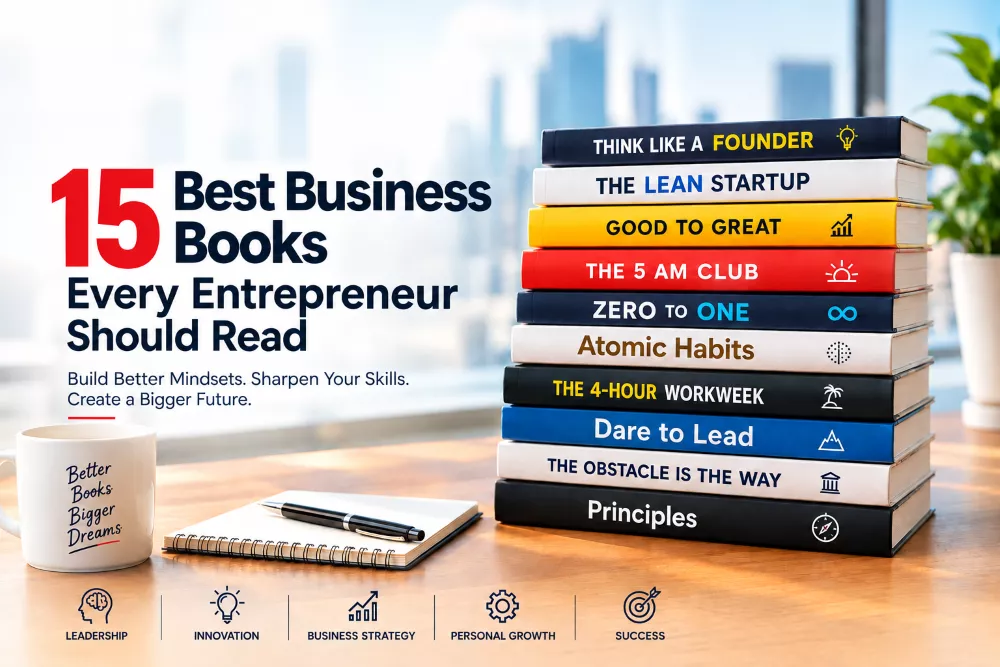
Nobody needs a hundred business books. Most repeat each other, and reading them can become a comfortable way of avoiding the actual work. But a handful have changed how founders think and are worth the time.
We’ve grouped these 15 by the problem you’re likely facing, so you can read what fits your stage instead of working through a list in order.
When you’re testing an idea
- The Lean Startup by Eric Ries (2011). The book that popularised the minimum viable product and the habit of testing assumptions before spending money. Its core loop of build, measure, learn is still the best antidote to building something nobody wants.
- Zero to One by Peter Thiel with Blake Masters (2014). A provocative argument for creating something new instead of copying what exists. You won’t agree with all of it, and that’s useful. It forces you to defend your idea’s originality.
- Rework by Jason Fried and David Heinemeier Hansson (2010). Short, blunt and happy to dismiss conventional wisdom on funding, planning and growth. Read it for a different view on staying small and profitable.
When you’re running the thing
- The E-Myth Revisited by Michael E. Gerber (1995). Many founders build themselves a job instead of a business. Gerber’s lesson is to design systems so the company can run without you. Dated in tone, still accurate.
- Profit First by Mike Michalowicz (2014). A practical cash-management method for small businesses: set aside profit first, then run the business on what remains. Not a theory book, more a habit to adopt on Monday.
- High Output Management by Andy Grove (1983). Written by Intel’s longtime leader, it treats management as a measurable craft. It’s the book to read the first time you hire someone.
When you’re growing
- Crossing the Chasm by Geoffrey Moore (1991). Early adopters will buy almost anything new. Mainstream customers won’t. Moore explains why so many promising products stall between the two, and how to cross the gap.
- The Innovator’s Dilemma by Clayton Christensen (1997). A sobering study of why well-run companies lose to smaller rivals. Founders should read it to learn how disruption works. Incumbents should read it for the fear.
- Blue Ocean Strategy by W. Chan Kim and Renée Mauborgne (2005). The argument is that you can sidestep brutal competition by creating a new market space. The examples are uneven, but the thinking tool is valuable.
- Good to Great by Jim Collins (2001). Widely admired and widely criticised, because several of its featured companies later struggled. Read it for the ideas on disciplined leadership, but don’t treat its formulas as law.
When you’re dealing with people
- Never Split the Difference by Chris Voss (2016). A former FBI hostage negotiator on how to listen, ask the right questions and negotiate without pressure. Useful for pricing, suppliers and salary talks alike.
- Influence by Robert Cialdini (1984). The classic on persuasion, built on decades of psychology research. Read it to sell better, and also to notice when someone is using these tricks on you.
When you need perspective
- Shoe Dog by Phil Knight (2016). Nike’s co-founder tells the early years with candour: cash crises, near-bankruptcies and luck. It’s the one book on this list people read for pleasure, and it reminds you that every big company began as a shaky one.
- The Hard Thing About Hard Things by Ben Horowitz (2014). Horowitz skips the success formulas and writes about the worst moments: layoffs, failed deals, sleepless nights. Founders often say this is the one that made them feel less alone.
- Thinking, Fast and Slow by Daniel Kahneman (2011). Not strictly a business book, but it explains the mental shortcuts that distort decisions about hiring, pricing and risk. Dense, so read it slowly.
How to actually use this list
- Pick one, not fifteen. Choose the section matching your current problem.
- Act within a week. After each chapter, write down one change you’ll make.
- Mix in a critic. Pair an optimistic book with a sceptical one, for example Zero to One with Rework.
- Read biographies as well as how-tos. Stories like Shoe Dog stick longer than frameworks.
- Abandon books freely. If a book isn’t helping by page 50, move on.
The bottom line
No book will build your business. The best ones sharpen your questions, shorten your mistakes and remind you that others have been through it. Start with one that matches where you are today.