
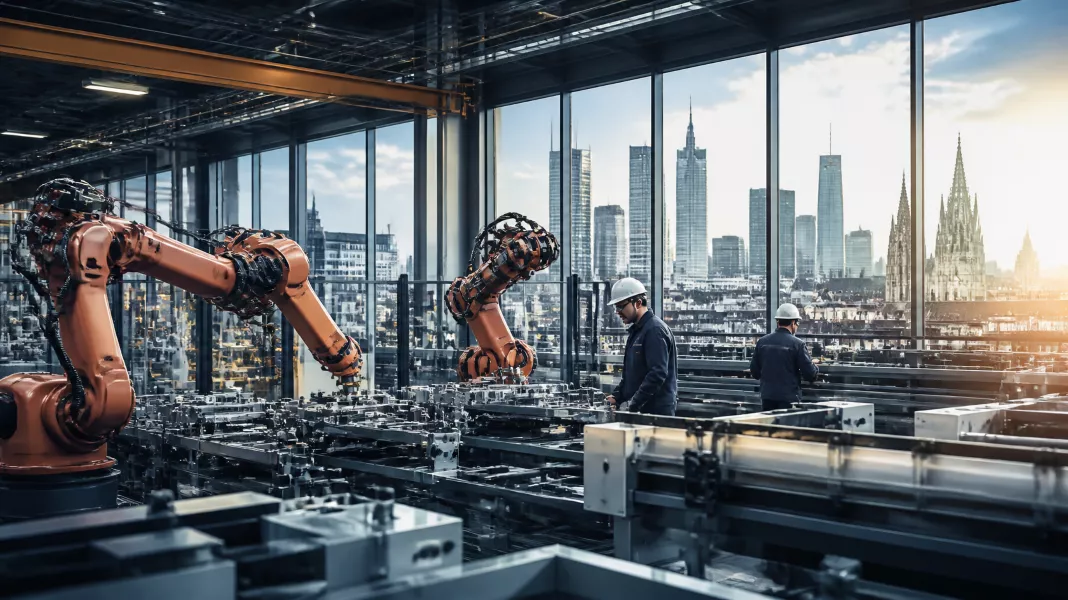
Europe’s Industrial Base Finds New Momentum as Factory Activity Strengthens
The manufacturing sector in Europe is displaying signs of renewed strength following a long period of weak industrial activity, giving businesses and investors a more optimistic view of the region’s economic prospects.
The most recent figures from the euro-area purchasing managers’ survey indicated that factory activity expanded at its fastest rate in over four years in August. This rise is especially noteworthy since manufacturing has been one of the weakest sectors of the European economy over the past few years.
The recovery is not evenly spread throughout the continent and companies are still having to deal with high energy costs, international competition and uncertain trade conditions. Yet the rise in factory orders and production suggests that Europe’s industrial economy could be entering a more stable phase.
Reuters has reported that factory growth in the euro-zone reached a level which is its highest for more than four years in August.
Manufacturing Becomes a Key Economic Indicator
Manufacturing is still of strategic importance to Europe; Germany, Italy, France, Spain, the Netherlands and a number of Central European economies possess large industrial complexes linked to the automotive, machinery, chemicals, pharmaceuticals, electronics and advanced engineering sectors.
For a large part of the most recent period, industrial companies experienced weaker demand, higher energy prices and greater competition from manufacturers based outside Europe.
The fact that factory activity has improved therefore has important implications that go beyond those of individual companies.
Greater production can help to sustain jobs, support logistics companies, industrial suppliers and business investment. It can likewise boost the confidence of companies which had put off capital expenditure due to uncertainty.
The automotive industry is still one of the most closely watched sectors.
European manufacturers are reorganising their production to focus on electric vehicles, software, battery systems and more efficient manufacturing platforms, while Chinese manufacturers are increasing their involvement in international markets.
It therefore means that European companies cannot depend entirely on their existing market positions.
Energy Costs Remain a Major Concern
A major challenge still facing European industry is energy.
European manufacturers have taken many years to get used to the higher energy costs, and sectors that are energy intensive—such as the chemical, metal, glass, paper and industrial materials industries—remain especially vulnerable.
Energy markets have once again been subjected to pressure due to recent geopolitical developments.
On September 7 the European equity markets were influenced by rising oil prices and by renewed worries regarding inflation.
For manufacturers, energy prices have an effect on all aspects of production costs as well as on transportation and pricing decisions.
Consequently, companies are coming to see energy management as a strategic matter rather than just an operating expense.
For industries competitiveness, investment in renewable generation, long-term power agreements, energy efficiency and local energy infrastructure is growing in importance.
Investment Could Follow Improved Demand
A continued recovery in the manufacturing sector might lead European companies to boost their level of investment.
In certain industries spending on capital has been kept back since the executives are uncertain as to what the future demand will be.
Making improvements to the orders could alter that calculation.
possible for manufacturers to start making investments in automation, robotics, production software, semiconductor equipment, industrial cybersecurity and energy-efficient machinery.
A study released this year showed that most European manufacturers anticipated growth in 2026, efficiency still being a key reason for their technology investments.
This suggests a more general change in manufacturing in Europe.
The next stage of industrial growth will not be based solely on employing more workers or building more factories. Instead, companies are considering ways of producing more efficiently with the resources they already have.
Europe’s Industrial Competition
The competition in the field of manufacturing has become greater on a global scale.
China has consolidated its standing in the fields of electric vehicles, batteries, solar equipment and a number of other industrial sectors, while the United States keeps on drawing in large-scale investment by means of industrial policy and incentives.
Europe therefore has to deal with a strategic question—namely, how its companies can stay competitive at the same time as they maintain environmental standards, worker protections, and their higher operating costs?
The solution is likely to be a mix of technological advances, improvements to the infrastructure, assurances regarding energy security and direct investment in industry.
The Clean Industrial Deal of the European Commission is based on the aim of making decarbonisation a factor in promoting industrial growth.
What Comes Next
The recovery in manufacturing is still in its early stages.
They will have to decide if the increased activity in factories can lead to continuous investment and higher corporate profits.
The industrial recovery offers investors a number of opportunities in the areas of machinery, automation, logistics, semiconductors, energy infrastructure and industrial technology.
The problem for policymakers is to keep the conditions unchanged so that European manufacturers can compete on a global scale.
The industrial economy of Europe is not going back to the earlier conditions; it is moving into a new stage—one characterised by automation, energy security, supply-chain resilience and the struggle for technological leadership.
The manufacturing figures for August are a promising indication.
The really important one will be if that improvement carries on during the last months of 2026.